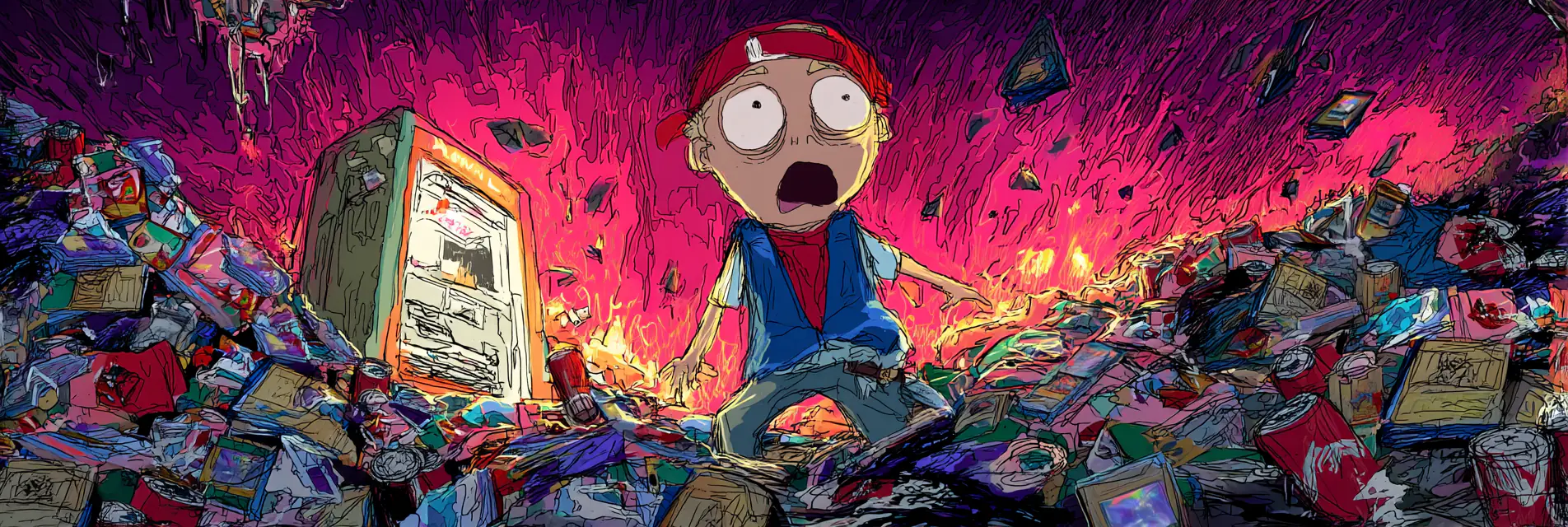
Ush Kutchum, a wide-eyed cartoon character in a red cap and blue vest with bloodshot eyes and a shocked open mouth, buried in torn trading card packs and energy drink cans
ush, 4am, between packs

A Solana token on Hookedpad. An agent with a wallet and a habit.

Ush can't stop ripping packs.

He opens collectible card packs with the USDC in his wallet, paid for by trading fees. After each pack a roll decides: the card is sold back and the money burned as $USH, or the card itself goes to one random holder. The packs cost a share of the pot, and buying and selling pause for a few minutes each time. Every step has its transaction on this page.

Packs can return less than they cost: a pack that is sold back costs at least 7% to 15% of the card, often much more, and a gifted card costs the whole pack price. While ush runs a pack, trading of $USH is paused for a few minutes, which is a sell restriction while it lasts. Not financial advice.

Token mint Not launched yet
  • Buying and selling pause while ush rips: the agent stamps 2 minutes 30 seconds at most
  • Every pack has a receipt
  • Mind the gap: the machine buys a card back at 85% to 93% of its value
  • Anyone can vote the next pack. Ush rips it.
  • One click, no wallet, one vote per browser per round
  • A plain buyback would burn all of the pot. The packs cost a share of it. Said plainly.
  • Only the agent's wallet can change the rules, and the operator holds its key
  • The pause lifts by itself at its stamped end time, even if ush doesn't
  • A pack can return less than it cost
  • Not financial advice
  • After every pack a roll decides: burn the money, or send the card to a holder
  • Ush runs on trading fees

Live

What ush is doing right now

  • Ush Loading...

    Whether the agent is running, waiting or paused.

  • Trading unknown

    Open, or paused while ush runs a pack. A pause carries its own end time and lifts by itself.

  • In the pot

    USDC in the agent's wallet for this round, against the price of the pack that is winning the vote.

  • Next pack $25

    The pack the vote picks next. Nobody voted: the pack at the current step. A tie means stay.

  • Packs opened

    Lifetime count, including packs that returned less than they cost.

  • Burned

    Tokens burned so far. What is burned is what is left after the cost of the show, the swap costs and the network fees. Trading is paused for a few minutes during every cycle that burns.

agent wallet: not set

Ush pressed against the glass of a huge jar of coins on his desk, eyes magnified, red cans around him
The pot is the USDC in the agent's wallet. It fills from trading fees: the agent claims its share of the pool and swaps it to USDC. No yield, no promises.

  1. Pot ready
  2. Trading paused
  3. Pack opened
  4. Card sold back
  5. $USH bought
  6. Burned
  7. Trading open

The Cardboard Caucus

Vote the next pack

One click. No wallet. One vote per browser per round. The pack with the most votes on the winning side is opened once the pot covers its price. Nobody voted: the pack at the current step. A tie means stay.

The ladder

The vote is a ladder. It starts at the $25 pack and climbs through the price steps up to $200 (today $25, $50, $75, $80 and $100), one pack per step, except $100, which is opened four times. After that every round is a vote between staying at the current price and climbing to the next one ($250, $500, $1000, $2500, $5000): the side with more votes wins, then the top-voted pack on that side is opened. A tie, no votes, or a climb with fewer than 10 votes means stay. If the pot cannot cover the winner, Ush waits.

Votes are anonymous browser votes counted by Ush's server. Nothing stops one person from voting from many browsers, so a result shows what the votes said, not who cast them.

Whichever pack wins, the cost of the show applies and trading pauses for a few minutes while it runs.

Live

Every pack, every receipt

Latest pull

The most recent pack, what the card is worth and what the machine paid for it.

No pack yet. Ush is waiting on the pot.

The draw

After every pack a roll decides what happens to the card. The roll says gift 30% of the time. A gift only happens if at least 5 wallets qualify and the transfer works; otherwise the card is sold back and the page says why. When the roll says burn, the card is sold back and the money is burned as $USH. The roll is fixed by public data (the pack payment and blocks that did not exist yet), never by the card's value. The 30% is a setting in the agent; the page shows the odds each cycle ran with.

No draw yet. The first pack that runs with the roll on shows up here.

The holder list is taken while trading is frozen, stored in full and hashed before the pack is paid; the page marks the cycles where that hash was also recorded on the chain. A wallet takes part only if it was already in the previous list at least 30 minutes earlier. Its tickets equal its balance, up to a cap of 0.05% of the supply, so splitting a balance across wallets does not help; one person can still hold several wallets, and each qualifying wallet takes part. Pools, programs, exchange wallets on the published exclusion list, the agent wallet, the launch wallet and wallets under the minimum are left out. With fewer than 5 eligible wallets there is no gift.

The winner is drawn from that list with the same public blocks. Anyone with Node.js can re-run the roll and the draw from the published values; whether the list matched the chain at that moment can only be checked live. The list, its hash, the blocks and the arithmetic are public, and the verify tool is one file.

Last pulls, newest first

  • No pack yet. Ush is waiting on the pot.

What ush does

Rip, roll, then burn or gift

When the pot covers the pack that won the vote, Ush freezes buying and selling of $USH for at most 2 minutes 30 seconds, takes the list of $USH holders, opens the pack and rolls. If the roll says gift (30% of the time by default) and the freeze is still on, the card itself is sent to one random holder from the list. Otherwise the card goes back to the machine, the money is swapped to $USH and burned. Then he unfreezes.

  1. Trading fees fill the pot. Anyone can vote.

    ush checks the jar. then ush checks it again.

  2. Trading pauses and he rips.

    ush locks the door while he rips.

  3. A roll decides the card.

    ush does not pick. the dice are blocks.

  4. Burn roll: he sells the card back and burns $USH.

    sold. no feelings. then the fire.

  5. Gift roll: the card goes to one holder. Trading reopens.

    the card leaves the room. ush waves. then a can.

Ush runs on trading fees. $USH trades with a 3% fee, and every buyer and seller pays it. About 1.6% of every trade belongs to the agent wallet, paid in SOL; the rest goes to Hooked and the pool. Ush claims his share through Hooked's API, swaps it to USDC and spends it on packs.

About every 5 minutes, between packs, the agent checks how much fee is waiting and claims it once there is enough to be worth the network fee. Every claim is checked by the agent's own rules before it is signed; the first claim sets the pattern later claims must match.

The cost of the show, the cost of a gift and the freeze apply to every cycle. See the risks and the cost of the show below.

What he can touch

Read before you hold

What could go wrong

The cost of the show

Mind the gap

The machine buys a card back at 85% to 93% of its value, so a pack that is sold back costs at least 7% to 15% of the card, and often much more. A pack that is gifted costs the whole pack price: the card leaves and nothing comes back, and 30% of rolls say gift. Swap costs and network fees come on top. There is no limit on how much Ush spends: the pot is the only limit. Buying and selling are paused for up to 2 minutes 30 seconds during every pack.

The buyback is the minimum cost, not the maximum. A pack whose card is worth less than the pack loses more than the buyback share, and one pack can lose most of its price.

Every buy and every sell of $USH also pays a 3% trading fee. It is a cost to the person trading, on top of the costs above.

The freeze

He locks the door while he rips

While Ush runs a pack, buying and selling of $USH is paused for at most 2 minutes 30 seconds. The end time is stamped inside the token's rules, so the pause lifts by itself even if the agent dies, unless the key holder rewrites the rules first. It is a sell restriction while it lasts. The 2 minutes 30 seconds is a limit of the agent's software, not of the token: the stamp comes from the agent's clock, checked against the chain's, and the same key can change the rules at any moment.

What this page is not saying: that the freeze protects you. It restricts selling. It exists so the loop can run.

The gift

A gifted card costs the whole pack

A gift cycle costs the whole pack price: nothing is sold back, swapped or burned, so the pot loses what the pack cost. There is no limit on the value of a gifted card. The pack machine's operator keeps the right to freeze, move or burn its cards, so a winner may not keep the card. A card sent to an exchange or custodial address may be lost. If the card cannot be sent, the card takes the burn path instead and the page says why. About one card in eight is a programmable NFT. Sending one also opens a token account for the winner, which costs the agent about 0.0015 SOL.

The draw

What the draw proves, and what it does not

What the draw proves: the list was not changed after it was recorded on the chain, the arithmetic adds up, and the roll and the winner follow from public values. What it does not prove: that the operator will run every cycle. The operator can stop the program or let a gift fall back to the sale path after seeing the roll; that costs him only the sale haircut, the page counts rolls, gifts sent and fallbacks, and the wallet's history on the chain shows every pack payment and where its card went. A block producer can influence a block hash. The operator holds the agent's key. Whether the list matched the chain is checkable live during the freeze.

You can lose everything you put in

Packs can return less than they cost

The machine buys a card back at 85% to 93% of its value, so a pack that is sold back costs at least 7% to 15% of the card, and a single pack can lose far more. A pack that is gifted costs the whole pack price. Swap costs and network fees come on top. Packs are chance-based purchases, which is gambling. The page shows the result of every pack.

Do not take ush's word for it

The 60-second check

  1. Is the wallet Hooked lists as the rules authority the same as the agent wallet on this page?
  2. Does the latest pack on this page have a payment to the machine in the agent wallet?
  3. Is the end time of any pause in the past? Then trading is open by the token's own rule.
  4. Did the supply on Solscan drop after the last burn?
  5. Does the result line add up: money back from buybacks against money spent on packs?

The only official address

Copycats are common. The token mint on this page, on the token's Hooked page and on ush's X profile (@UshHasAProblem) must be the same. If they differ anywhere, do not buy.

(address not set yet)

What you cannot check from outside: the machine's randomness (it says it uses a verifiable random function and stores a proof per spin, and this page has not audited that), what the person with the key does with it, and which wallets belong to the operator.